
AI adoption should come with a plan
These tools are so easy to start with that rollouts become procurement exercises — buy the seats, hand them out, wait for productivity. The research says what happens next. A few weeks of planning avoids it.
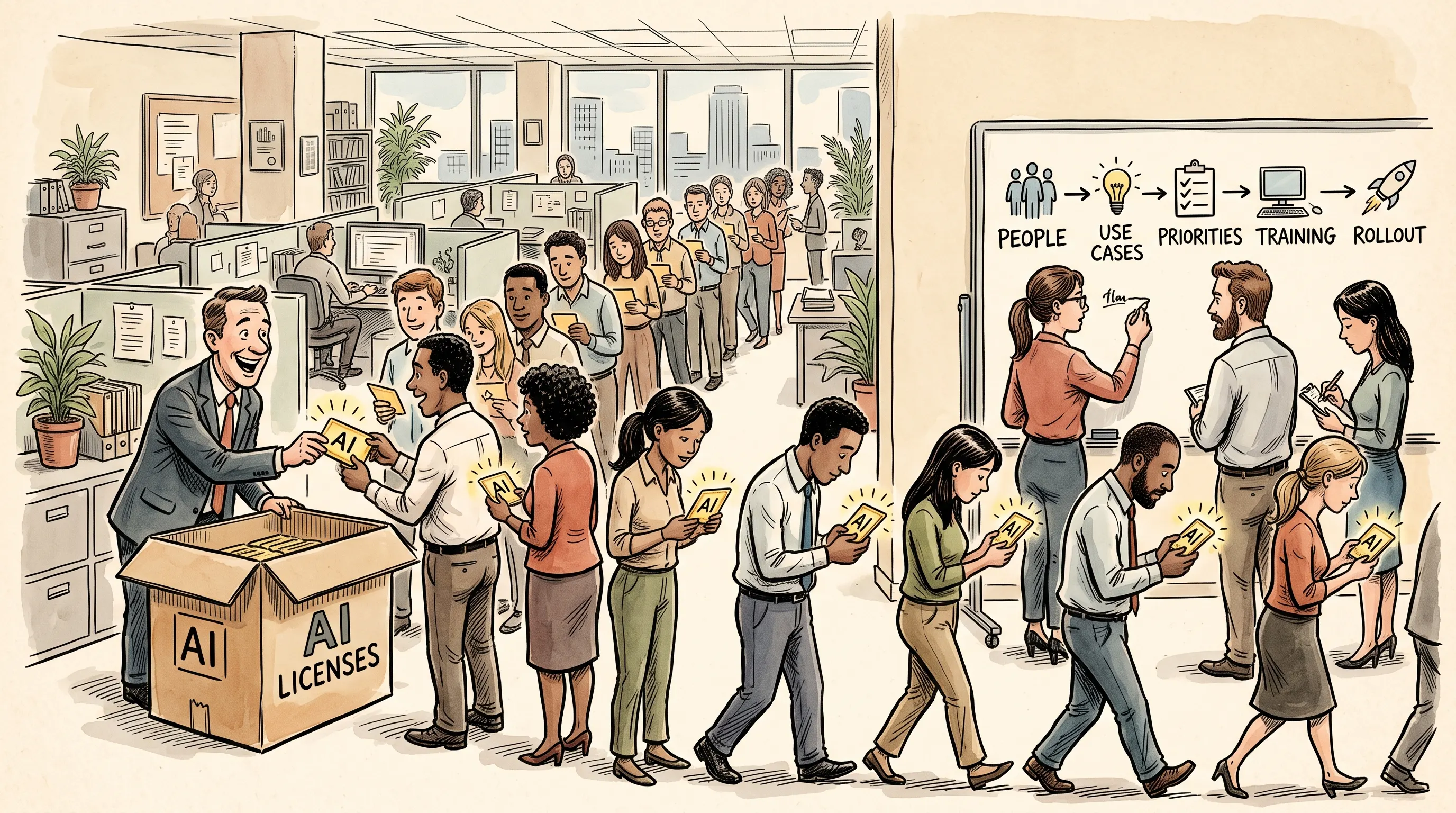
AI adoption should always come with a plan. Not a big one — but a plan.
The reason it usually doesn’t is that these tools are unusually easy to start with. You type a question, you get a fluent, confident answer. It looks like the value arrives with the license. So the rollout becomes: buy the seats, hand them out, wait.
What follows is predictable.
People love using it. They use it more. They get comfortable — generic questions, the first answer taken as correct, no verification. And the output looks equally polished whether it’s right, mediocre or totally wrong.
The mistakes then travel on to whoever receives that work.
The research is consistent on this
Microsoft Research and Carnegie Mellon surveyed 319 knowledge workers about how they actually use these tools at work. The finding: the more confidence someone placed in the AI, the less critical thinking they applied. Confidence in your own expertise worked the other way — it made people check more, not less.
BetterUp Labs and Stanford’s Social Media Lab put a name on what lands downstream: workslop — AI output that looks finished but isn’t. About 40% of employees surveyed had received some in the previous month, and dealing with each instance cost roughly two hours of rework. The polish is the problem: it moves the cost of quality control from the sender to the receiver.
Harvard and BCG ran the largest field experiment, with 758 consultants. Inside AI’s capability range, real gains — faster, better work. Outside it, people using AI were 19 percentage points worse than people using none. The boundary between those two zones is invisible from the output, which reads confident either way.
And people don’t notice when it’s costing them. METR ran a randomized trial with experienced open-source developers: with AI available they were about 19% slower — and afterwards estimated it had made them 20% faster. A nearly 40-point gap between what happened and what they believed happened. If you’re piloting AI, measure the pilot; don’t survey the satisfaction.
None of this is a character flaw. A randomized experiment with 2,784 participants found people were less likely to fix an erroneous AI suggestion when fixing it took extra effort, and when they liked AI more. That’s automation bias — a predictable default we all carry, which is exactly why it needs a plan rather than a memo.
BCG’s rule of thumb for where AI value actually comes from puts it plainly: 10% algorithms, 20% data and technology, 70% people and process. The license is part of the 10%.
The plan
The fix isn’t complicated, and it isn’t slow:
- Identify one or two key users per department — people who know their own processes
- Collect candidate use cases from them, not from IT
- Prioritize the list, quick wins first
- Train those people until they’re genuinely fluent
- Then roll out the licenses, following the priorities
One honest caveat on step 4, because it matters. The Harvard/BCG study included a group that got a prompt-engineering overview, and it wasn’t enough on its own. Ethan Mollick’s follow-up is direct about it: prompt-technique training alone doesn’t fix this, and organisations that push adoption without attending to how people integrate the tool end up with what he calls self-automators — people who hand the whole task over and stop thinking.
The field’s view of the skill itself has also shifted. Phrasing tricks matter much less than they did in 2023; modern models read intent well. What replaced them is context — giving the model the material and framing it needs, then checking the result against your own domain knowledge. “Learn to prompt” is slightly the wrong label. “Learn to work with it” is closer, and it holds up better.
So train task selection, context, and verification. Not a prompt-tricks course.
A few weeks of work. What it buys is the difference between people who produce volume and people who produce value.
And that shift isn’t gradual. Once fluency clicks it jumps — the same people delivering more, better and faster, and compounding from there.
Discussion
Comments for this post live off-site so the conversation stays where readers already are.